

Responsible Sourcing Strategy Without Systems Change Is Just Gardening
How growth imperatives prevent sustainability strategies from succeeding by Anne Oudard

I come to this conversation as a denim consultant who has spent years helping brands develop fabrics and products, and rebuild their relationships with their supply chain. Working inside sourcing systems has made something increasingly clear to me: fibre strategy alone cannot fix the economic model driving overproduction. This piece is my attempt to trace the economic logic shaping the system we all move within.
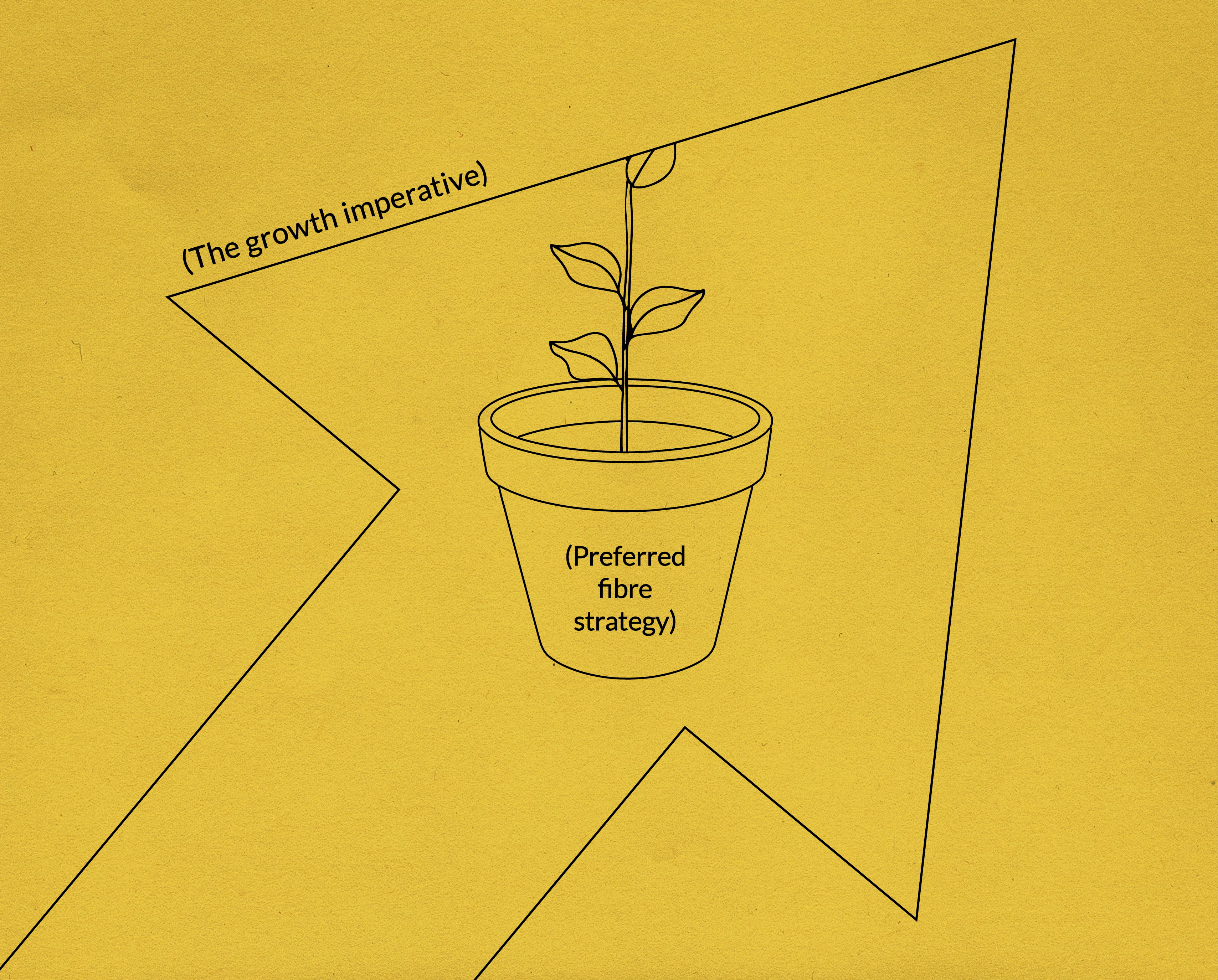
Autumn last year, I attended the Textile Exchange conference and I was genuinely excited to see a “Reimagining Growth” conference on the agenda. I have been waiting for the moment when conversations about materials sit alongside conversations about economics, finance and ownership. Textile Exchange has opened that door before through earlier post growth keynotes, so this felt like it could be another step forward.
The discussion was around modelling durability, resale, and longer life products. But as the session unfolded, I couldn’t help feeling stuck in the same old timeloop. The conversation stayed anchored in fibre switching strategy and circular-ish business models without touching the ownership structures that force companies to keep expanding production to satisfy shareholders and investors.
The underlying logic remained the same: grow, but grow “more responsibly” to keep protecting a system built on endless accumulation of profit for the 1%.
I left the conference recalling a quote I read from the economist Jason Hickel: “Decisions about what to produce and how to use our collective surplus should be democratically determined, rather than controlled by and for the interests of capitalists and the 1%.”
The textile industry is still very far from that. And unless we start addressing this deeper economic design, no amount of “preferred fibres” or resale platforms will keep us within planetary boundaries.
What’s missing from the Current Conversation
Textile Exchange’s report “Reimagining Growth” on which the conference was based, begins by acknowledging the need to move beyond growth, but quickly reframes the discussion to avoid the term ‘degrowth’ because according to a study they carried in 2024 “65% of participants from the industry believe they could not use the word “degrowth” internally in their organizations”.
The word degrowth can be easily misunderstood, avoiding it may be pragmatic, but is this a reason to discard the whole concept it carries?
What if we anchored the conversation in something more concrete and operational: limits. Companies are used to working within limits: limited budget, limited time, limited capacity… In fashion companies, collections are limited too. Every season, the amount of products that’ll be developed and produced are strategically defined and limited to fit within a budget. So what would happen if companies also defined limits to their profits? Would we need to produce and sell as much?
The latest update of the Doughnut Economics framework provides country level data on social shortfall and ecological overshoot of planetary boundaries. I believe this methodology could be applied to companies. For younger brands, this could mean defining a clear point of stabilization rather than indefinite scaling. For larger brands, it could mean identifying where contraction is needed to return within planetary boundaries while securing a solid social foundation.
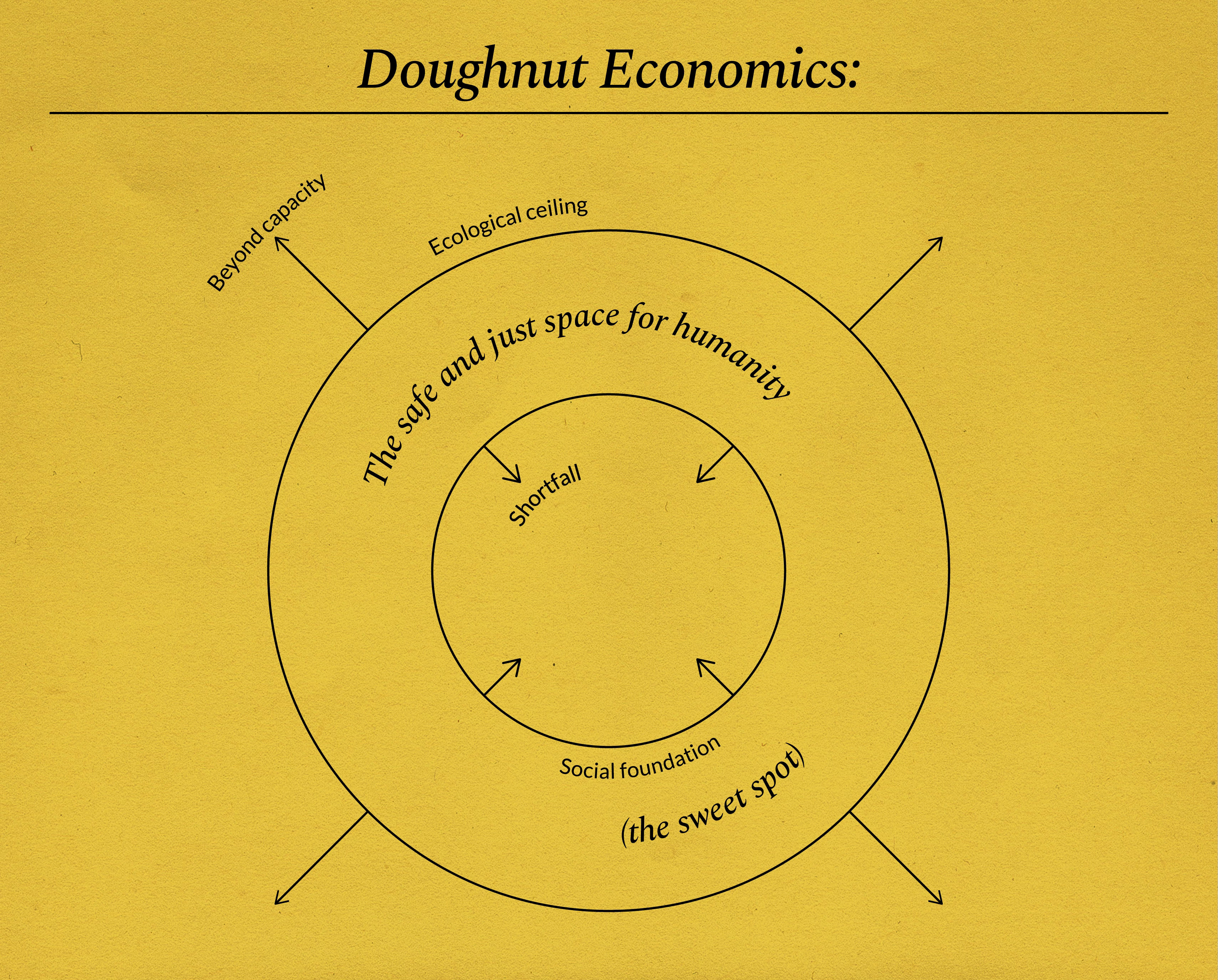
Limitation is not decline, it is balance. It is deciding to stop growing once enough has been reached.
The challenge is that our current economic structures are not designed to recognize such limits. The assumption that companies must continue to grow remains deeply embedded in how success is measured and financed. Growth is not neutral: it determines what we produce, how we design, who we employ, and what we sacrifice. When shareholder profit is the primary organizing principle, everything else (emissions, resource use, repair, wages) becomes negotiable.
The Myth of Green Growth
To understand how we’ve been pushed to protect the current growth-dependent system, we need to look at the idea that has guided sustainability thinking for nearly forty years: the belief in “Green Growth”.
Green Growth theory promises that we can keep expanding the economy while reducing our environmental footprint, and this belief has shaped sustainability strategies for decades. It is the reassuring story that efficiency and innovation will let us maintain the same economic logic while somehow reducing impact. It is appealing because it promises continuity. The problem is that this promise has never happened in reality.
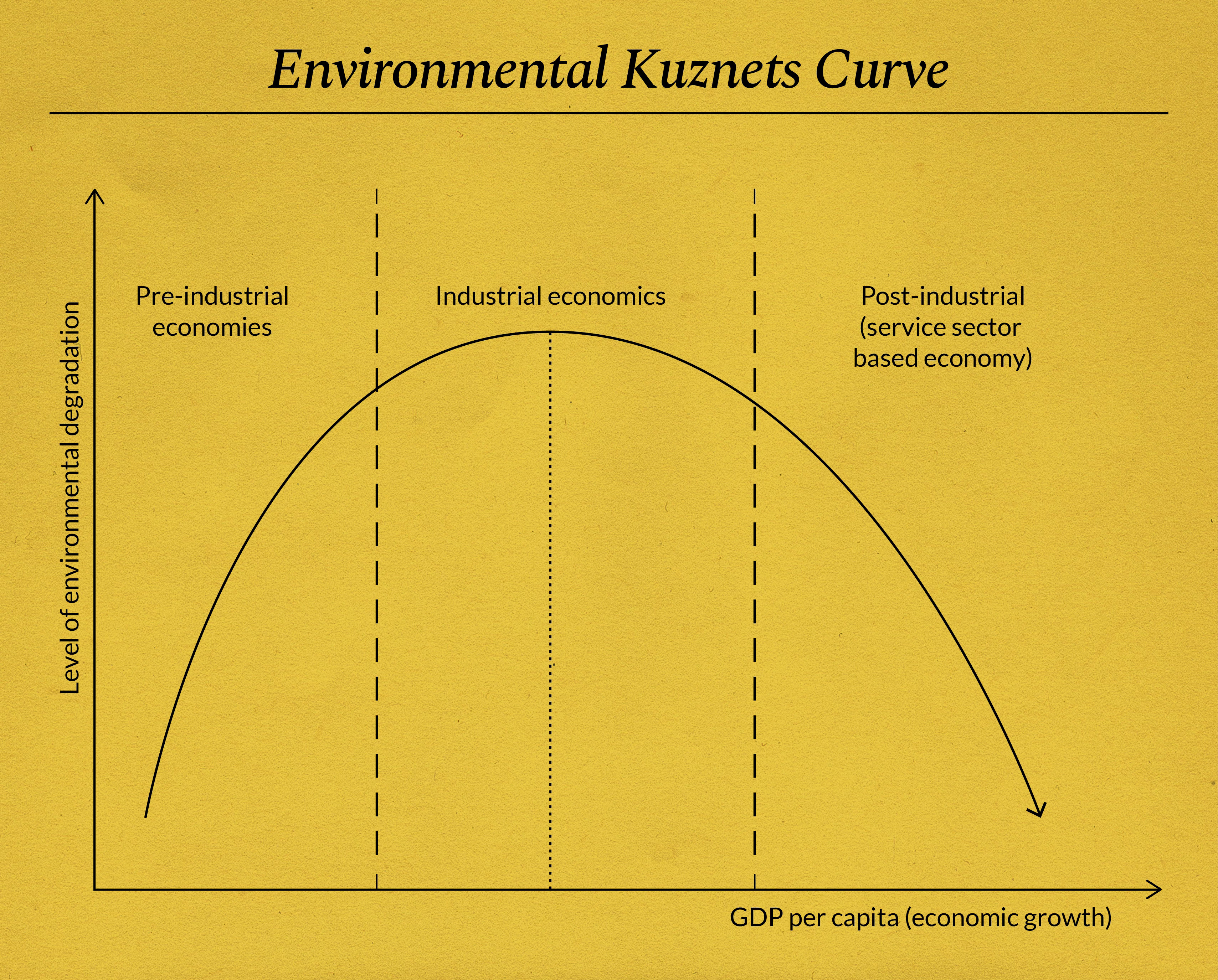
This idea was popularized in the 1980s through the “Environmental Kuznets Curve,” which suggested that pollution that rose in early industrialization will eventually fall as economies shift to services. It was a reassuring hypothesis, and an unfounded one. In reality, global material and energy use have continued to rise, even in the wealthiest, most service-based economies, a trend now being accelerated by the rush to AI and data centres.
In the paper “Is Green Growth Happening?”, Jason Hickel and Jefim Vogel show that a few high-income countries have managed to reduce their territorial CO₂ emissions while continuing to grow GDP. However, the observed rate of decoupling is so slow that it would take over 200 years to reach the emissions reductions the Paris Agreement expects by 2050! And crucially, none of these countries have decoupled growth from total material use, which continues to rise.
Additionally, efficiency gains don’t necessarily lead to less impact; they often lead to more. When production becomes cheaper or faster, total output tends to rise. This is called the rebound effect. The textile industry is a textbook case: cheaper fibres, accelerated lead times, and even “sustainable” collections have all fuelled higher consumption, not lower.
The economist Timothée Parrique has developed a three steps program to cure our addiction to growth and actually reduce ecological impact. The program should be followed in this order (emphasis on “in this order”) :
First: Reduce the scale of what we do (produce and consume less)
Second: Shift modes (for what remains, choose lower-impact alternatives, like preferred fibres)
Third: Improve efficiency (optimize processes through innovation)
Our industry tends to start at step two and misses the most important one: Reduce the scale.
How Company Structures Impact Change
Even if the science is clear, the structure of modern corporations makes real change nearly impossible. Economist and entrepreneur Eva Sadoun explains this vividly in her book Une économie à nous (An economy of our own).
She recounts how Emmanuel Faber, former CEO of Danone, was dismissed after transforming the company into a “mission-driven company.” Investors revolted, not because of poor social or environmental performance, but because the earnings per share had stagnated compared to competitors like Nestlé.
As one fund manager told Le Monde at the time: “Faber was so busy building a better world that he forgot to create value”, and my question is: value for who?
That single quote says everything about why green growth fails. Value only means profit and in a market where CEOs are judged quarter by quarter, even modest attempts to prioritize sustainability are seen as weakness. Leaders aren’t failing because they don’t care; they’re navigating incentives that reward short-term earnings over long-term resilience. Sadoun cites research showing that a company’s innovation capacity drops by 40% after going public. If we want different outcomes, we need different governance and financing logics, not just for firms trapped in quarterly cycles, but also for governments constrained by electoral timelines.
So how do we free companies from this growth trap?
We can start by changing who they’re accountable to. I’m a big fan of Lita.co, the impact investment platform founded by Eva Sadoun. Instead of chasing anonymous shareholders, companies raise funds directly from citizens who care about their mission, a large pool of small investors who value impact and transparency over maximum returns.
In France, brands like Patine and Loom have used Lita to finance their growth on their own terms. Both have built business models around durability, transparency, and moderation, and their funding reflects that ethos. For Loom, financing through its community via Lita has meant rejecting the typical startup growth race, structuring operations around slower, more deliberate production, and making choices like foregoing sales and promotions, resisting rapid scaling, and prioritizing product quality and ethical supply chains precisely because it doesn’t have to answer to venture capital chasing quick returns. When your investors are your community, you’re not forced to double your sales every year. You can focus on doing better, not just more.
These kinds of structures makes me very enthusiastic as they offer a glimpse of what post-growth capitalism could look like: companies designed for sufficiency, not for endless expansion; governance rooted in democratic accountability rather than shareholder pressure.
If our funding models rewarded enough instead of more, we could finally make products that last and businesses that don’t have to overproduce to survive.
Towards Real Degrowth for the Textile Industry
The way I see degrowth doesn’t look at all like collapse, it means redesigning an economy that thrives without perpetual expansion. For the textile sector, this starts with rethinking the foundations that make growth mandatory in the first place:
Rethink ownership: create cooperatives, social enterprises, and mission-driven companies that distribute power and profit more fairly. Models are already at work in cotton producer-led cooperatives like OBEBAP in Benin and COFE in India. Their practices were documented in Stories from the Ground by Cotton Diaries and A Growing Culture.
Align finance: with patient, community-based capital like Lita.co, freeing companies from the pressure of extractive shareholders.
Set clear limits to growth: before ecological thresholds are reached, prioritize better over more. Fewer collections, longer product lives, slower cycles, as brands like Loom have deliberately chosen to do.
Rebuild proximity between fibre, factory, and wearer, not only in distance, but in relationship, to restore accountability, resilience, and community value. Veja’s supply chain in Brazil shows what this can look like in practice: two decades of direct, long-term relationships with the communities producing its cotton, rubber, and recycled plastic. They recently documented their approach in Far from the Spotlight, a series of short films that center the people behind the sneakers rather than the brand itself.
Redefine success: measuring well-being, repair rates, and ecosystem restoration, not quarterly growth.
This is how reimagining growth could look like. Not hoping that the green growth silver bullet will save us, but by designing a new economy altogether, one that integrates limits as a starting point, not a negotiable constraint.
A Call for Courage
Reimagining growth will not get us there if we refuse to imagine beyond it.
Our textile industry needs courage. The courage to stop protecting a system that only profits a minority of investors and the courage to start redesigning a system that benefits the global majority while regenerating the planet.
If we want responsible fibre strategies to matter, we have to change the systems around them. Cotton cannot regenerate when the business logic above it demands volume over stewardship. Circular models cannot thrive when profit is tied to throughput. Soil health, farmer livelihoods, and genuine durability all depend on the same shift.
Textiles are a mirror of the wider economy: extractive, fast, and fragile. But they can also lead the way. If we dare to build companies that measure their success by the well-being of all the beings in their supply chains as well as their environment, not by how much profit they make for their shareholders.
Without that shift, we are not redesigning the system, we are only pruning around the edges.
Author’s note:
The title of this article was inspired by Chico Mendes famous quote: “Environmentalism without class struggle is just gardening.”
Further reading:
Is green growth happening? An empirical analysis of achieved versus Paris-compliant CO2–GDP decoupling in high-income countries - Jefim Vogel & Jason Hickel
Decoupling Debunked, Evidence and arguments against green growth as a sole strategy for sustainability - Timothée Parrique
Why capitalism is fundamentally undemocratic - Jason Hickel
Une économie à nous, Changer de regard pour redéfinir les règles du jeu - Eva Sadoun
Less is More: How Degrowth Will Save the World - Jason Hickel
Slow Down or Die: The Economics of Degrowth - Timothée Parrique
With gratitude to those who keep pushing us to imagine economies that serve life, not profit.

Anne Oudard is a denim consultant, supporting a number of brands with the development of their denim collections, from fabric sourcing to product design. Over the past years, she’s being directing her efforts towards building transparent supply solutions in the denim industry, encouraging fashions brands to reconnect with cotton farmers.
Regarding the topic of the article, thank you for articulately identifying the crucial distiction between superficial 'green' initiatives and the fundamental need to reform ownership structures and economic logic that perpetuate overproduction and profit acumulation for the few, which is truly insightful.
This is the conversations we need to having!! I am becoming very fatigued with all the resale, next gen material, textile recycling, and any other great innovation talk that should in theory, “transform” the industry. Because, as you’ve said, if all that innovation is growing in tandem with overall production, then the system is not changing.
I love the model of operating a business within limits and assessing the environmental limits in which they should plan to operate. I also love how you say that textile industry usually starts with the second step, making the change systematically ineffective because they keep skipping step one.
Also, I also attended the TE conference in Lisbon! I could tell they really made an effort to gather voices from all points of the value chain and promote discussions about cost sharing, collaboration, and equity, but too felt like the underlying root problem was not often grazed.. how can we start producing and consuming less ?